
Hey there, smart investor! Let’s be real for a minute. If you are keeping your hard-earned money in a traditional savings account or standard Fixed Deposits (FDs), you are losing purchasing power to inflation every single day.
On the flip side, the stock market can feel like a wild roller coaster ride that keeps you up at night.
So, where do you find that sweet spot of high returns without taking reckless risks?
Enter Peer-to-Peer (P2P) Lending.
Once considered an alternative financial experiment, P2P lending in India has matured into a heavily regulated, institutional-grade powerhouse. We are talking about net yields ranging from 15% to 25% per annum—a number no traditional asset class can touch right now.
But as a savvy investor, your first question should be: “How safe is my principal?”
Today, we are lifting the hood on Non-Banking Financial Company-Peer to Peer (NBFC-P2P) platforms. We will break down every single security feature, micro-detail, and RBI regulation that works tirelessly behind the scenes to keep your capital secure.
Phase 1: The Invisible Shield (How Borrowers Are Vetted)
Before a borrower's profile ever goes live on a platform, they must pass through a brutal, automated digital screening process. Platforms act as high-tech gatekeepers, filtering out high-risk applicants through a three-layered security check:
- Real-Time Credit Bureau Filtering: The platform hooks directly into the APIs of all four major RBI-licensed bureaus (TransUnion CIBIL, Experian, Equifax, and CRIF High Mark). The system automatically tracks historical repayment timelines, debt utilization ratios, and how many loans they have recently applied for. If there is a recent default or a history of written-off loans? Automatic rejection.
- Deep Income & Cash Flow Analysis: No self-reported income slips through the cracks here. The system links directly with bank statement parsers, GST portals, and Income Tax e-filing systems. It calculates advanced financial metrics like the Debt-to-Income (DTI) ratio. For small businesses, it verifies consistent monthly recurring revenue; for individuals, it ensures a stable salary history.
- Identity Verification & Digital Footprint Magic: Identity fraud is stopped dead in its tracks using paperless central databases like Aadhaar e-KYC and PAN verification. Advanced machine learning tools then analyze alternative digital data—like utility bill payment consistency and transaction habits. This helps judge not just a borrower’s ability to pay, but their willingness to pay.
Phase 2: Micro-Diversification (The Ultimate Safety Net)
If you take only one thing away from this blog, let it be this: In modern P2P lending, you never put all your eggs in one basket. In fact, you shred your basket into tiny pieces.
The absolute secret weapon of P2P investing is fractional capital deployment.
Let’s Look at an Example:
Imagine you deposit ₹1,00,000 into your P2P account. Instead of lending that entire amount to one person or business, the platform's automated engine chops your money into tiny fragments and spreads it across 400 different borrowers.
Your exact investment per borrower is a microscopic ₹250.
          [ Your ₹1,00,000 Investment Portfolio ]
                             │
       ┌─────────────────────┼─────────────────────┐
       ▼                     ▼                     ▼
Borrower 001          Borrower 002          Borrower 400
  (₹250)                (₹250)                (₹250)
How Co-Sharing Completely Dilutes Your Risk:
Say a small shop owner is seeking a loan of ₹25,000. Your portfolio automatically pitches in just ₹250 (which is only 1% of their loan).
Where does the remaining 99% come from? It is crowded-sourced from 99 other independent lenders who also chip in ₹250 each!
The Result: If that specific shop owner defaults and completely disappears, your total loss is capped at just ₹250. Meanwhile, the high interest generated by your other 399 performing loans easily absorbs that tiny bump, keeping your overall portfolio highly profitable.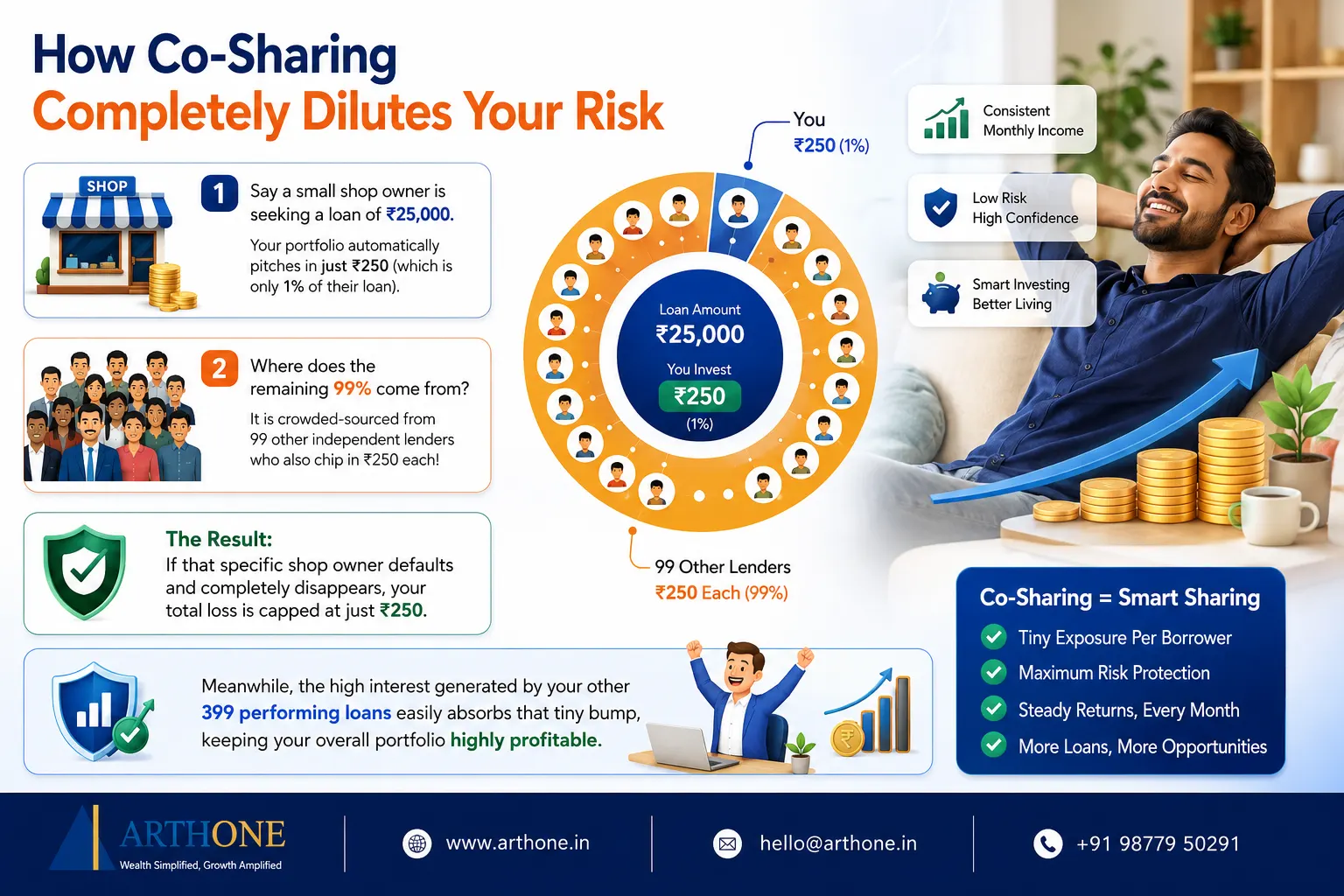
Phase 3: The Target Market & High-Velocity Loops
Where exactly does your money go? Platforms reduce defaults by targeting verified, high-yielding sectors through trusted channels:
- MSMEs: Micro, small, and medium enterprises that need immediate working capital to grow.
- Small Business Owners: Local merchants with rapid, daily/weekly cash turnovers.
- Salaried Professionals: Corporate employees clearing short-term personal needs.
Short-Term Loan Lifecycles
These are not long, decades-long home loans. P2P loans are highly dynamic, usually lasting between 3 to 12 months. Because the loan durations are short, your money recovers from the market incredibly fast. This high velocity protects your wealth from long-term economic shifts or unexpected market downturns.
Phase 4: The RBI Rules (Your Legal Safeguards)
P2P lending isn't a wild west operation. The Reserve Bank of India strictly regulates the entire ecosystem through its Master Directions for NBFC-P2P Lending Platforms. These regulations are designed entirely to protect you, the retail investor.
Here is a breakdown of what the law strictly mandates:
1. Hard Exposure Caps
- The Single-Borrower Cap: A lender cannot lend more than ₹50,000 to the exact same borrower across the entire P2P industry.
- The Total Investment Cap: The absolute maximum a retail investor can deploy across all P2P platforms combined is ₹50 Lakhs.
- The Net-Worth Gatekeeper: If you decide to invest more than ₹10 Lakhs, you must submit a net-worth certificate from a practicing Chartered Accountant (CA) confirming you have a personal net worth of at least ₹50 Lakhs.
- The Borrower Cap: A single borrower cannot take more than ₹10 Lakhs across the entire P2P industry.
2. The Dual-Escrow Account Rule (Bankruptcy Protection)
The platform never touches your cash directly. Under RBI rules, your funds must flow through an independent bank-operated Escrow Account managed by an independent trustee.
- Lender Escrow: Holds your cash before it is disbursed to vetted borrowers.
- Borrower Escrow: Collects repayments from borrowers before passing them back to you.
Because your money is held by an independent bank trustee, even if the P2P platform itself shuts down or goes bankrupt, your money and loan contracts remain completely safe and untouched by corporate creditors. Furthermore, funds cannot sit idle; all disbursals and repayments must clear within a strict T+1 business day window.
3. Total Transparency and Strict Prohibitions
To keep the market honest, the RBI places strict bans on what platforms can do:
- No Credit Guarantees: Platforms are legally prohibited from giving principal or interest guarantees. Lenders take on the pure credit risk, which is why proper micro-diversification is so vital.
- No Guaranteed Returns Language: Platforms cannot advertise these assets as guaranteed fixed-income tools.
- No Secondary Markets: Platforms cannot let investors sell their ongoing loans to other investors for quick early exits. Loans must run their natural course.
- Unsecured Only: All loans are strictly unsecured commercial or personal contracts.
- No Self-Lending: Platforms act strictly as marketplaces. They cannot lend money from their own corporate pockets.
4. Fortnightly Bureau Reporting
Platforms are legally obligated to report repayment histories to credit bureaus every 15 days. Borrowers know that skipping or delaying an EMI will ruin their personal and business CIBIL scores in less than two weeks. This creates immense psychological pressure on borrowers to pay their debts on timeReady to Diversify and Boost Your Fixed Income Returns?
Now you know exactly how the machinery works. P2P lending combines cutting-edge data science, automated fractional risk-splitting, and robust RBI regulations to offer retail investors an incredibly rewarding asset class.
Don't let your wealth sit idle under low-yield traditional instruments. It's time to build a smart, secure, and diversified alternative income stream.
Take control of your financial growth today. Reach out to the experts to discover tailored, risk-mitigated lending strategies built for you.
Connect with us right now at arthone.in to get started!

About the Author